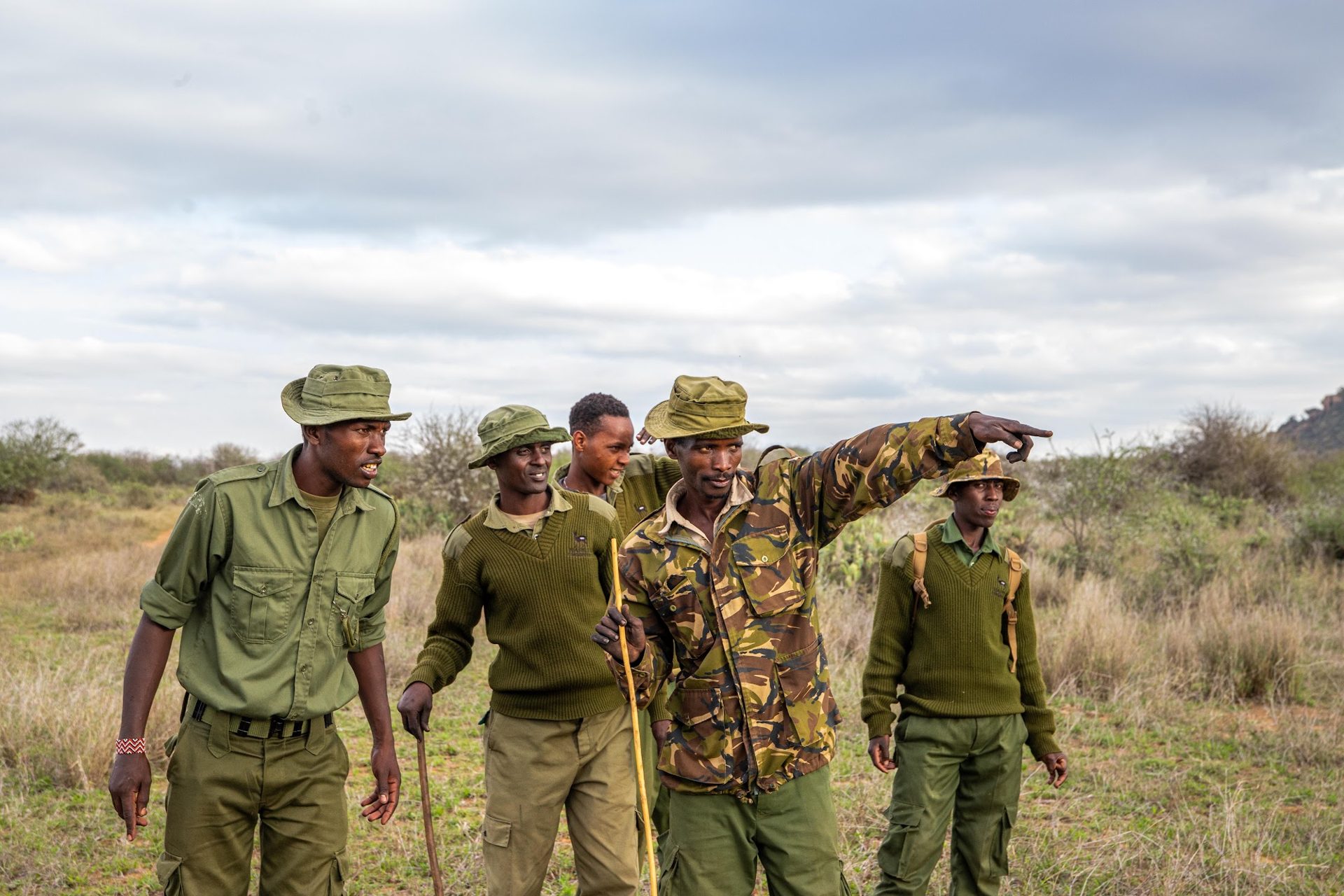
It is 5:30 in the morning and the cold has not yet lifted. The sun is still somewhere behind the Mukogodo hills, and the only light is a thin grey band along the ridge. Four community scouts stand at the edge of a homestead, boots already red with volcanic dust, listening. Somewhere to the east a cowbell clinks. Then nothing.
The corporal leading the patrol crouches over a patch of soft ground near the thorn fence. The print is the size of a dinner plate, the edges still sharp. “She passed here maybe two hours ago,” he says, pressing two fingers beside it. “Going toward the lagga. She knows there is water under the sand.”
He is talking about an elephant. Most mornings at Nareto start like this.
Walking the same paths as the herds
Nareto’s scouts work on foot. The landscape of northern Laikipia is acacia thorn-scrub broken by dry sandy riverbeds, and vehicles cannot follow the routes that elephants and livestock both use. So the scouts walk, often ten kilometres or more before mid-morning, reading dung, broken branches and trampled grass the way other people read a newspaper.
The aim is simple: know where the animals are before they reach the homesteads. When a herd is moving toward a settlement or a water point that families use, the scouts call ahead. Herders can move their cattle. Mothers can keep children close. A shamba can be watched through the night.
“The problem is never the elephant alone,” says one scout who has patrolled these hills for several years. “The problem is when nobody knows it is coming. Then people are surprised, the animal is surprised, and somebody gets hurt.”
When encounters do happen, the scouts’ first job is to calm things down. That can mean standing between an angry farmer and a herd that has broken into a maize plot, talking for an hour while the animals drift off. It can mean helping a family record the damage properly so that it is reported. It rarely means anything dramatic. Patience does most of the work.
A boma that holds through the night
Elephants are not the only worry. Hyenas and leopards take goats and sheep, and a family that loses three or four animals in one night has lost real money. Losses like that are where anger against wildlife begins.
So part of the scouts’ work happens with fencing wire and thorn branches rather than binoculars. With families, they help build predator-proof bomas: a ring of chain-link fencing, reinforced at the base, with cut thorn brush packed tightly around the outside. It is hot, slow work. The wire has to be tensioned by hand and the thorns tear at forearms.
“Before, we used only thorns,” an elder explains, standing beside a newly finished enclosure. “The hyena would push and push until it found a weak place. Now with the wire, it walks around and goes away. My goats sleep. I sleep.”
Every boma that holds is one less reason for a family to see predators as enemies.
Reports from the field, in real time
At the end of each sighting the corporal pulls out a mobile phone. Location, species, number of animals, direction of travel, any conflict with people or livestock. It takes a few minutes, often with the phone held up to catch a signal from the right side of a hill.
These digital reports build a picture over weeks and months: which routes the elephants prefer in the dry season, which homesteads see the most predator attacks, where patrols need to go next. Information that once lived only in one scout’s memory is now shared, checked and used for planning.
The technology has limits. Batteries die. Networks drop. Some days a report waits until evening, when the patrol is back near a charging point. But the scouts say it has changed how they work. “Now when we tell the committee there is a problem in one area, we can show them,” one says. “It is not just our word.”
Why the scouts come from these homesteads
Every Nareto scout is recruited from the local community. That is not a detail. It is the reason the system works.
A scout from outside would be a stranger with a uniform. A scout from here is somebody’s son, someone’s neighbour, the young man who used to herd goats along the same lagga. People tell him things. A herder mentions fresh tracks near the borehole. A woman collecting firewood reports a snare. A shopkeeper hears that strangers have been asking about the area.
“If they did not trust us, we would see nothing,” the corporal says. “We would be walking blind.”
That trust also runs the other way. Because the scouts live with the same pressures as everyone else, lost goats, failed rains, crops trampled overnight, they understand why people sometimes get angry at wildlife. They do not lecture. They listen, and then they help.
By ten o’clock the sun is high and the cold is a memory. The patrol turns back toward the homestead where it started. The elephant’s tracks lead down into the lagga and disappear under the sand. Tonight, the families nearby know she is close, and they are ready.
That is what protection looks like at Nareto: not a fence around the wild, but people who know it well, walking it every morning, so that families and wildlife can keep sharing the same ground.